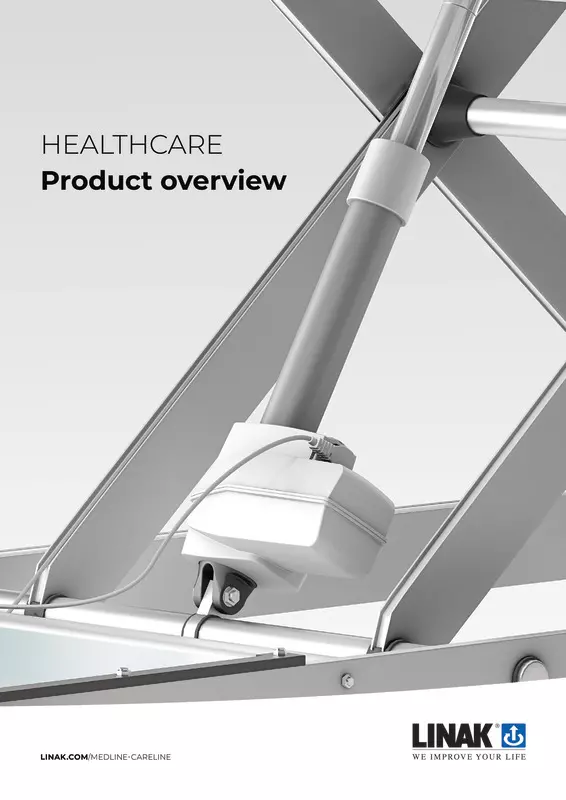
How does a linear actuator work?
An electric linear actuator operates by receiving a power supply, which energises its internal electric motor. This motor converts rotational movement from electrical energy into linear movement.
Through the interaction of a lead screw or ball screw and a nut, the actuator transforms this rotational movement into linear displacement along its output shaft. This mechanism allows for precise control and positioning of the actuator in various applications.
Read more here: What is an actuator?
Electric linear actuators with a wide range of specifications
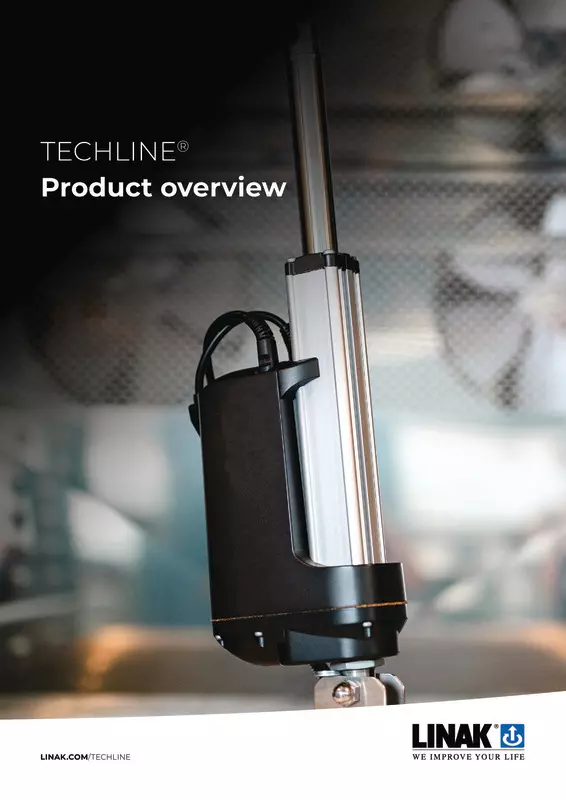
At LINAK, we design and manufacture a wide range of electric linear actuators tailored to meet specific application requirements. Our actuators come in various speeds, stroke lengths, and capacities, ranging from the compact inline LA20 to the robust LA36.
Our actuators are designed to move loads from 40 kg to 1,500 kg (force from 400 N to 15,000 N), with a maximum speed of up to 160 millimetres per second (mm/s). We offer the following voltage options:
- 12 V actuators
- 24 V actuators
- 48 V actuators
All LINAK actuators can be customised to specific requirements, such as stroke length or high force, ensuring an optimal solution for the application.
With four global manufacturing locations, LINAK can build custom actuators and deliver in a timely manner. Contact LINAK to start developing an electric linear actuator solution for your movement requirements.
Business areas for electric linear actuators
LINAK electric linear actuators enable controlled movement in a wide range of applications across industries and everyday environments. They are used to adjust, lift, and position equipment in environments where precise and reliable movement is required.
These applications can be grouped into three main areas: industrial and off-highway equipment, healthcare and medical equipment, and workspace and residential solutions.
Industrial and off-highway equipment
Industrial and off-highway applications operate under demanding conditions and require robust and reliable solutions. Electric linear actuators can support this by enabling controlled and consistent movement in a wide range of machinery and equipment.
Actuator solutions are used across industries such as agriculture, construction, industrial automation, and marine, where precise adjustment and dependable performance are required in daily operation.

Healthcare and medical equipment
With increasing demand for elderly care and rising life expectancy, healthcare providers face the ongoing challenge of improving efficiency while supporting high standards of patient care. Electric linear actuators support this by enabling reliable and controlled movement in healthcare equipment.
Actuator solutions are used in various aspects of patient care, supporting functionality through features such as Under Bed Lights, WET sensors, and Out of Bed sensors.

Workspaces and residential
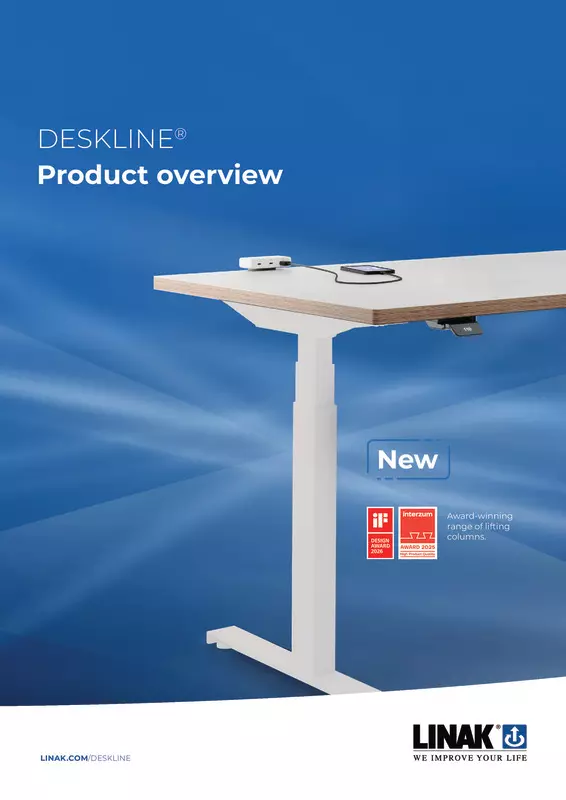
Modern work and living environments increasingly require flexible solutions that support comfort, ergonomics, and ease of use in daily applications. Electric linear actuators enable this by providing controlled and quiet movement in a wide range of products.
Actuator solutions are used in applications such as height adjustable desks, workstations, adjustable beds, and recliners, where smooth adjustment supports everyday use in both professional and private environments.


Accessories and advanced technology for electric linear actuators
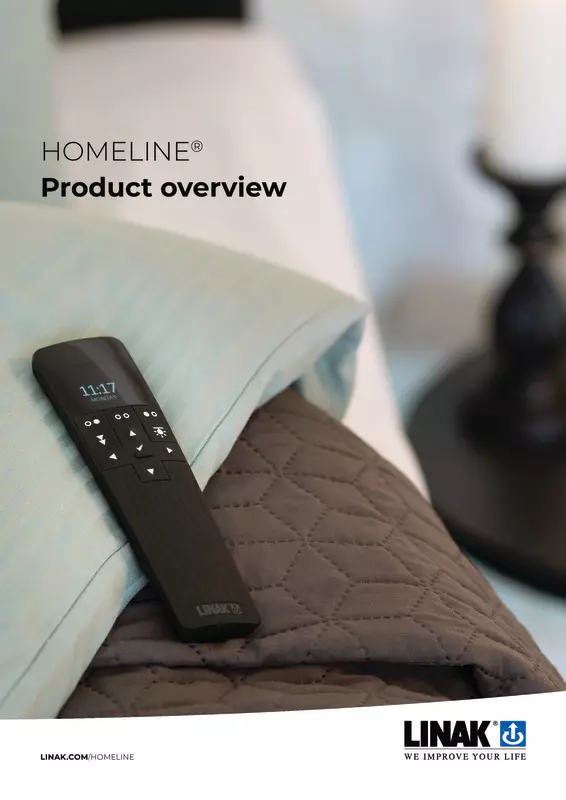
In addition to electric linear actuators and lifting columns, LINAK offers a wide range of control options and accessories designed to support efficient operation and precise movement. Control solutions include handsets, remote controls, foot switches, desk control panels, software, and mobile applications.
Actuators and accessories are designed for straightforward mounting and installation. Selected solutions include Integrated Controller (IC) technology based on H-bridge technology, offering features such as position feedback, virtual limits, soft start and stop, current limitation, and adjustable speed.
These solutions also support parallel movement and integrated BUS communication via industry standard protocols such as CAN SAE J1939 and CANopen.
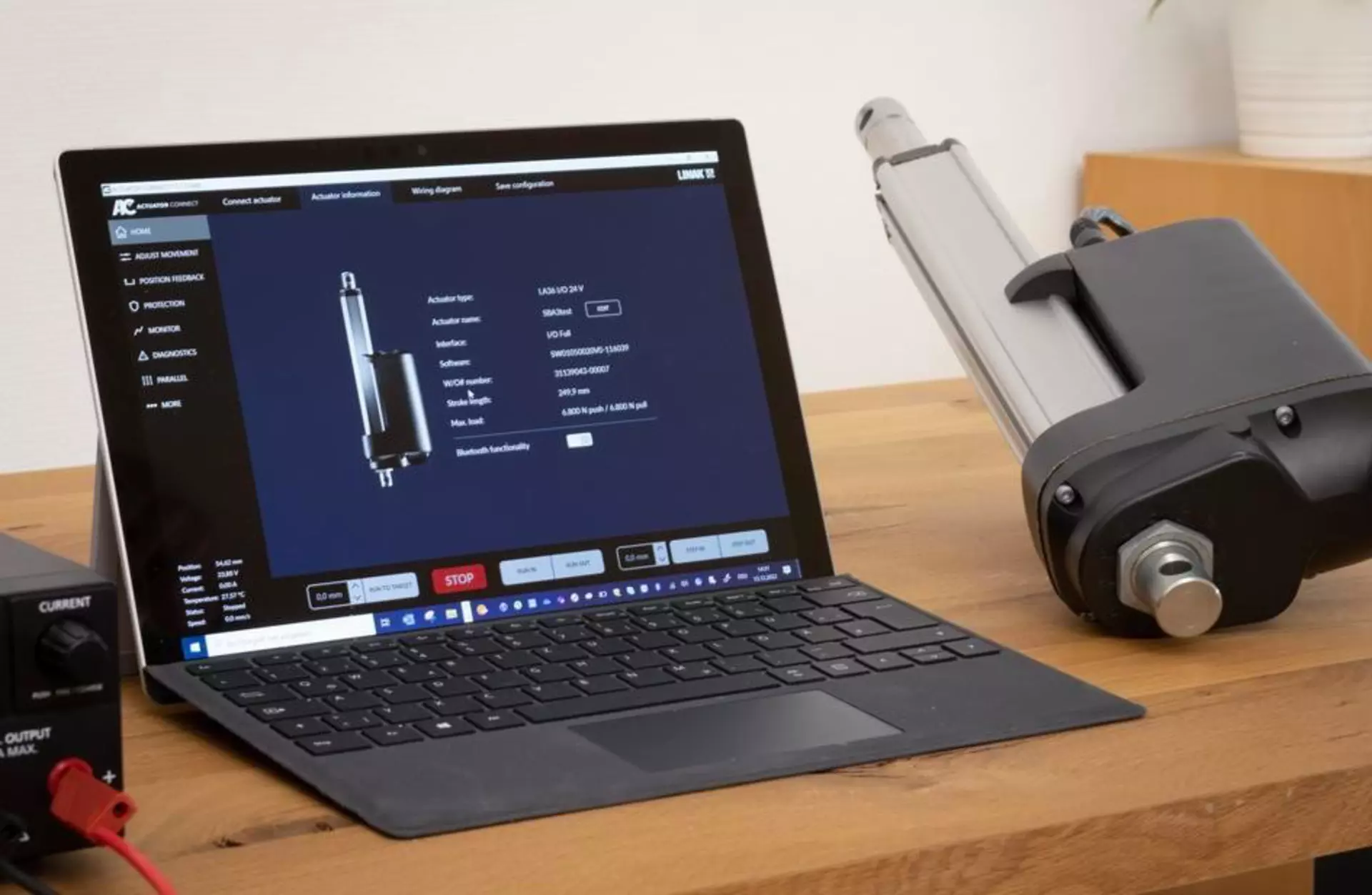
LINAK: The most trusted electric linear actuator brand
Reliable performance is essential for linear actuator solutions, which play a key role in enabling precise linear movement. To support this, actuator solutions are tested under demanding conditions to assess performance, durability, and resistance over time. Each actuator undergoes functional testing before leaving production.
Visit the page ‘Extensive testing – trust your industrial actuator’ for further information about testing methods and requirements.
LINAK specialists are available globally to support the selection and implementation of actuator solutions. Support is provided across functions including sales, research and development, application engineering, customer service, marketing, and quality, covering the process from specification to installation and operation.
Detailed production information is available online, including data sheets and manuals. A 3D configurator is also available to support product development and visualisation of actuator solutions.
Actuator Academy™
To gain more insight into electric linear actuators and their capabilities, explore the LINAK Actuator Academy™. Take a deep dive into the workings of linear actuators and discover more about precise control through our extensive video library covering technology, components, and control options.
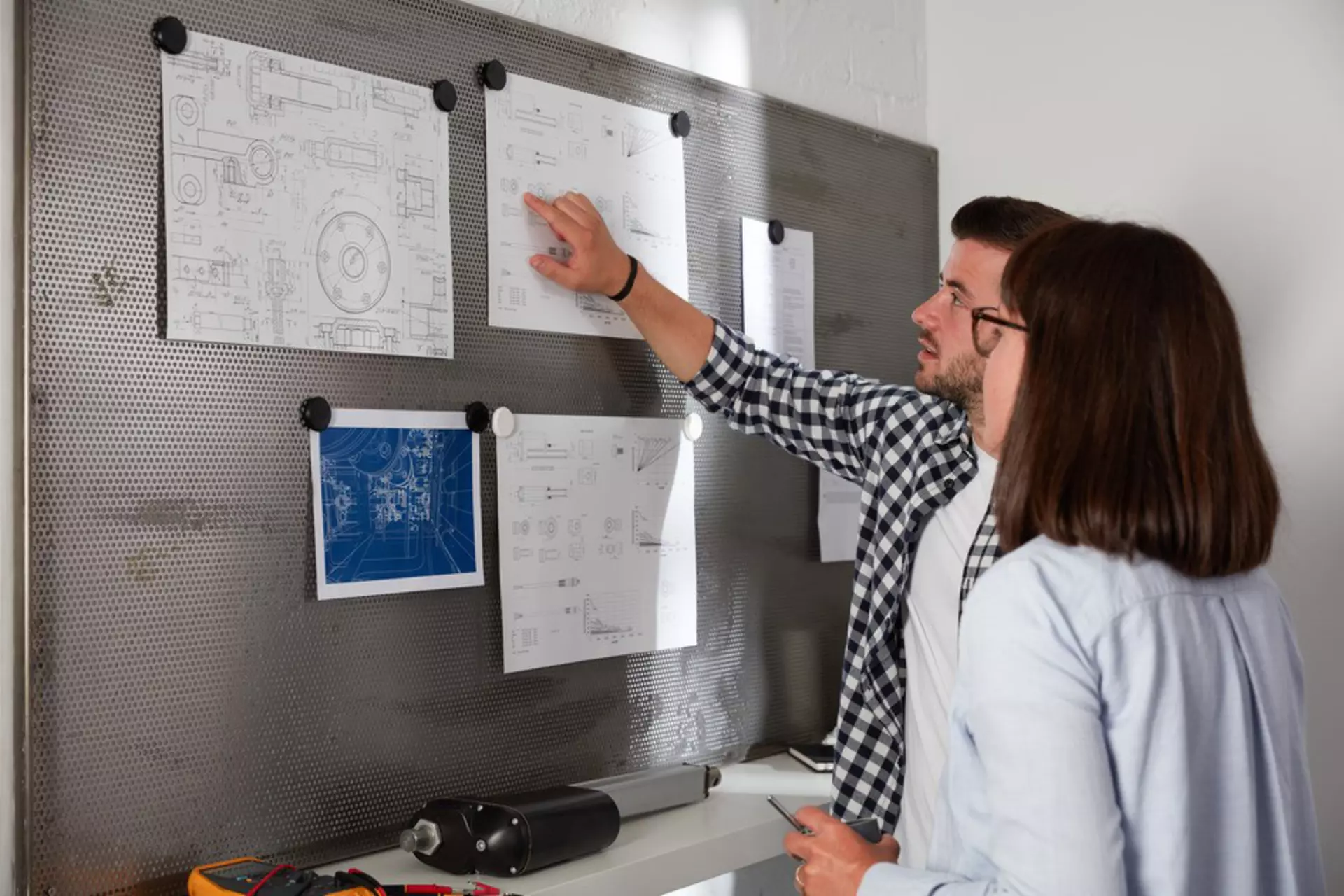
Actuators explained: Everything you need to know
Frequently asked questions
A linear actuator is a device or machine that converts rotational motion into linear motion and linear movement (in a straight line). This can be done through electric AC and DC motors, as we do at LINAK, or the movement could be powered by hydraulics and pneumatics.
However, electric linear actuators are a preferred option when precise and clean movement is needed. They are used for all types of applications where tilting, lifting, pulling or pushing with force is needed.
A common type of linear actuator is an electric linear actuator. It is made up of three main components: spindle, motor and gears. The motor can be AC or DC depending on the power needs and other influencing factors.
Once a signal is sent by the operator, which can be through a control as simple as a button, the motor converts the electric energy into mechanical energy, rotating the gears connected to the spindle. This rotates the spindle and causes the spindle nut and piston rod to travel outwards or inwards depending on the signal to the actuator.
As a rule of thumb, a high thread count and smaller spindle pitch will cause slow movement but a much higher load capacity. On the other hand, a low thread count, and higher spindle pitch, will favour fast movement of lower loads.
Visit the Actuator Academy™ and explore the aspects of what makes an actuator ideal for use with industrial machinery and discover the technology behind it.
There are many types and sizes of electric linear actuators. From small and compact that fit into tight spaces, such as in wheelchairs, to large and powerful to move heavy items like a wheel loader engine hood. In addition to size and power, there are also many different designs of electric linear actuators.
The original design has a motor housing that is outside of the gear and spindle profile. But when space is limited, an inline actuator is used so that the motor only extends the shape of the profile. For desks and some medical applications, lifting columns are used for an inline motor housing with two and three-stage options.
Since the founder and CEO of LINAK, Bent Jensen, made his first electric linear actuator in 1979, the company has continued to develop new actuators and refine the innovative technology behind them to improve movement solutions for several industries.LINAK designs and manufactures many types of linear actuators and lifting columns with various speeds, stroke lengths, and capacities. From the compact, inline LA20 to the robust LA36, LINAK actuators are built to fit almost any application.
With an almost endless list of customisation options to help design an actuator specifically to fit unique applications, the range of LINAK actuators is even greater than the vast product range listed.
Electric linear actuators increase efficiency and give users precision movement through a variety of control options and accessories. Control options for electric linear actuators include handsets, footswitches, desk controls, computer software, mobile apps and much more.
With no need for hoses, oils, or valves, electric linear actuators require no maintenance and create a safe environment for users. High-quality electric actuators are also put through a variety of tests that push the actuators to extremes. This is done to ensure optimal performance at any given time in any situation. They are also designed, along with their accessories, to be easily mounted and installed in a variety of applications,
making it easy for anyone to add precision movement where they need it. Being electric enables the addition of smart features like CAN bus (LINAK offers CAN SAE J1939 and CANopen for actuator controls). Integrated Controller (IC) solutions can provide various position feedback options, virtual limits, soft start and stop, current limitation, and adjustable speed.
Electric linear actuators are used in everything from private homes, the offices where we work, all areas of a hospitals, in production in factories, to farming equipment, and many other places. LINAK electric actuators create adjustment in both desks, kitchens, beds, and couches, as well as hospital beds, patient lifts, surgery tables among others in for example hospitals and medical centres.
Electric linear actuators can also replace hydraulic and pneumatic solutions in industrial and rugged environments – for example those found in agriculture, construction, and in industrial automation equipment.