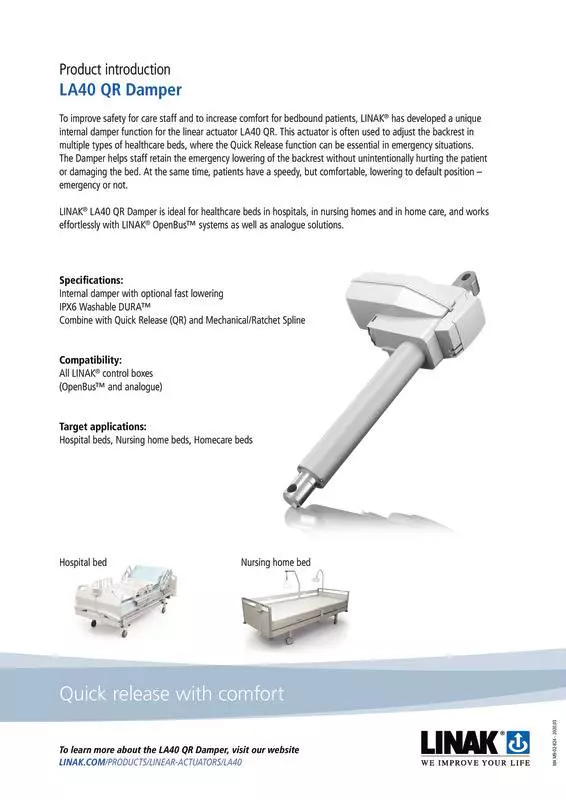
This actuator is often used to adjust the backrest in multiple types of healthcare beds, where the Quick Release function can be essential in emergency situations. The damper helps staff retain the emergency lowering of the backrest while at the same time ensuring a quick, yet comfortable lowering experience for the patient.
What to consider when testing the LA40 QR Damper in your healthcare application
- We recommend a minimum 30-minute cool-down period between activations
- The type and size of testing weights will affect the performance of the actuator
- The position of weights on the backrest will affect the performance of the actuator
- Using weights instead of a real person will give different test results as the damper is designed for real life use
FAQ
The damping feature does not make any additional noise compared to LA40 QR version.
When the damper feature engages, a low clicking sound can be heard. If the load is too light, the damping feature will disengage and will engage again when the speed is high enough.
A clicking sound will occur every time the damper feature engages.
LA40 QR Damper should not be tested on an air giraffe or on a pneumatic system. Testing in this way will lead to inaccurate test behaviour/results.
Please be aware that you need an external application feature to stop the fast movement, the mechanical end stop inside the actuator is not designed to stop any Quick Release movement.
Please note that the position and the use of the dead weights have a significant impact on the performance of the LA40 QR Damper. The most realistic test results can be obtained by using a real person as test subject on the application.
Dead weights can be used to test the LA40 QR Damper on the application, if the weight distribution of these on the frame is ensured to be as close as possible to the weight distribution of a person. Avoid unrealistic placing of the dead weights. This could for example be placing all dead weights on the top or middle part of the back frame. If doing so, retraction will be much faster.
Note that the dead weight will always have a faster lowering speed compared to person weight due to the different weight distribution on the bed frame's kinematic.
This will result in faster angular speed, since there is less resistance in the total actuator system. This will also cause the liquid inside the damper to get too hot and will eventually solidify and the damper will break.
There is only one type of damper, which is a damper filled with silicone oil.
No, the damper resistance always applies a constant resistance moment. This means that with a higher load on the frame, a higher lowering speed will be obtained.
The damper will engage with a mix of acceleration and at a high spindle rotation speed.
No, the damping feature follows the standard QR lifetime usage.
This sound is standard when engaging the damper. The damper is built on a sling clutch principle, where the damper resistance load is transferred between two metal parts resulting in a clicking sound every time the damper activates.
If it breaks down, the remaining actuator functions will work as normal, and there is therefore no added safety hazard. However, there may be unexpected noises during movement depending on how the mechanism fails.
Due to the different mechanical kinematics of each application and the spindle pitch, it is not possible to indicate a minimum weight to be placed on the frame that will activate the damper. Instead, the force on the actuator can be indicative and a force of between 750 - 1300 N is needed to activate the damper.
This could be due to a low load on the actuator, but not a specifically low load on the application, for instance high back frame angle on the bed.
In this way, the damper may not engage at all or engage with some intermittences.
If the recommended cooling time between each activation is not observed, the lowering speed will be faster each time the damper is activated. If the actuator is subjected to a higher load than specified, it will result in higher lowering speed.
No, this is not possible. The coupling point is related to lowering speed and not stroke length.
Yes, for internal use. Please contact the Sales Application Engineer responsible for supporting your subsidiary for further information.
Related documents

Related products
Related applications
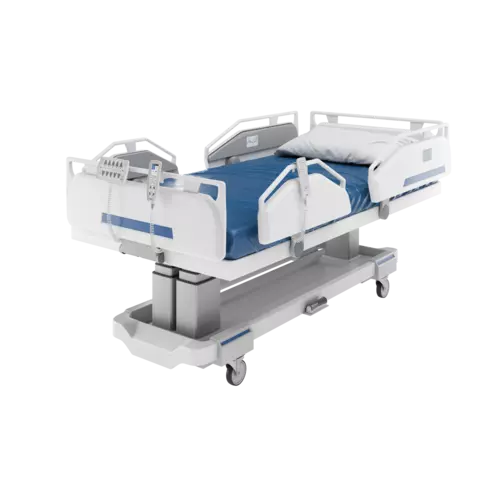
ICU beds
Serious and critical illness drive the increased need for beds in intensive care units. Using LINAK actuator solutions allows great design flexibility and freedom to customise the ICU bed for optimal movement, functionality and safety.
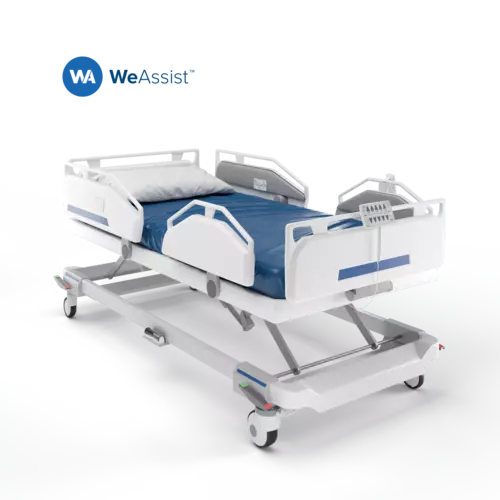
Hospital beds
The ageing population and fewer hands to take care of the patients drive the need for hospital beds. Using LINAK actuator solutions allows for optimal movement, connectivity to the hospital information facility and digital services – all increasing the caregiver efficiency.
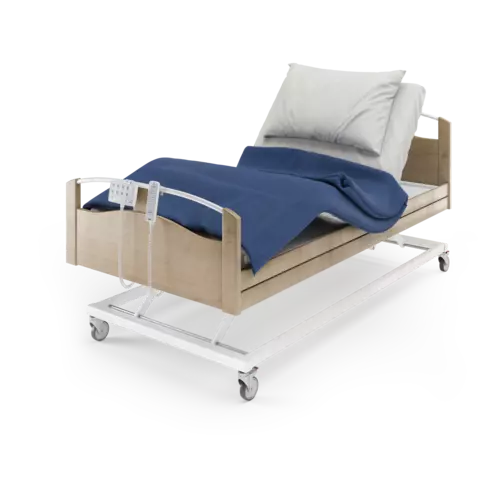
Nursing home beds
The ageing population and fewer hands to take care of the patients drive the need of nursing home beds. Using LINAK actuator solutions allows for optimal movement, supporting patient well-being and safety, as well as connectivity to the nursing home information facility and digital services – all increasing the caregiver efficiency.