An Ingress Protection rating (IP) is essential for ensuring that electrical equipment complies with the international standard, protecting it from environmental hazards like water, dust, and debris. This minimises damage, ensures safety, and extends equipment lifespan. By providing a standardised measure of protection, IP ratings help users select internationally compliant equipment suitable for their specific application requirements, promoting reliability and regulatory adherence.
How do I read an IP rating code?
The IP code always consists of the letters IP (Ingress Protection) followed by two digits and an optional letter. The two digits and the last letter indicate the classified protection below.
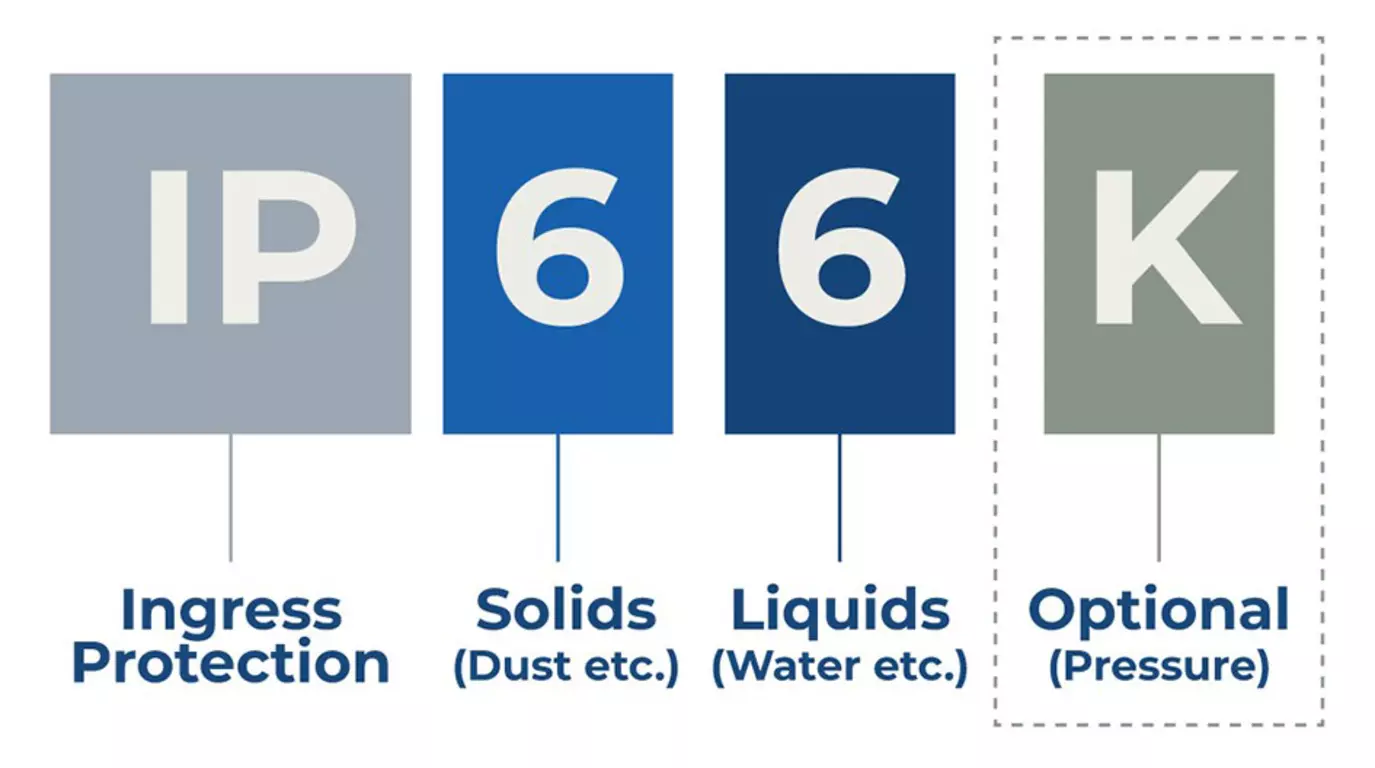
First digit in IP code: Solids protection
The first digit in the IP rating code indicates the level of protection against solid foreign objects and accidental contact with hazardous components, such as electrical conductors. This ensures the enclosure meets safety standards by preventing access to dangerous parts and protecting against dust and debris.
| Level | Object size protected against | Effective against |
|---|---|---|
X | - | X means no data available to specify a protection rating |
0 | Not protected | No protection against contact and ingress of objects |
1 | >50mm in diameter | Any large surface of the body. No protection against deliberate contact |
2 | >12.5mm in diameter | Fingers or similar objects |
3 | >2.5mm in diameter | Tools, thick wires, etc. |
4 | >1mm in diameter | Most wires, screws, etc. |
5 | Dust protected | Ingress of dust sufficient to cause damage inside the equipment operation. Complete protection against contact |
6 | Dust tight | No ingress of dust. Complete protection against contact |
Second digit in IP code: Liquids protection
The second digit in the IP rating indicates the degree of protection against water ingress. It distinguishes between resistance to low pressure water jets, high pressure water jets, and water tests, thus ensuring comprehensive safeguarding against water-related hazards.
| Level | Object size protected against | Effective against |
|---|---|---|
X | - | X means there is no data available to specify a protection rating |
0 | Not protected | No protection against water ingress |
1 | Dripping water | Vertically falling water drops |
2 | Dripping water when tilted < 15º | Vertically falling water drops when enclosure is tilted < 15º |
3 | Spraying water | Water sprayed at an angle < 60º from the vertical position |
4 | Splashing water | Water splashing against the enclosure from any direction |
5 | Water jets | Water projected by a nozzle (6.3mm) against the enclosure from any direction |
6 | Powerful water jets | Water projected in powerful jets (12.5mm nozzle) against the enclosure from any direction |
7 | Immersion up to 1m | Ingress of water when temporarily immersed (up to 1m of submersion) |
8 | Immersion beyond 1m | Ingress of water when continuously immersed (beyond 1m of submersion) |
9K* | Powerful high temperature water jets | Close-range, high pressure and high temperature spray downs*Identified as IPx9 in standard IEC 60529. All tests with the letter ‘K’ are defined by standard ISO 20653 |
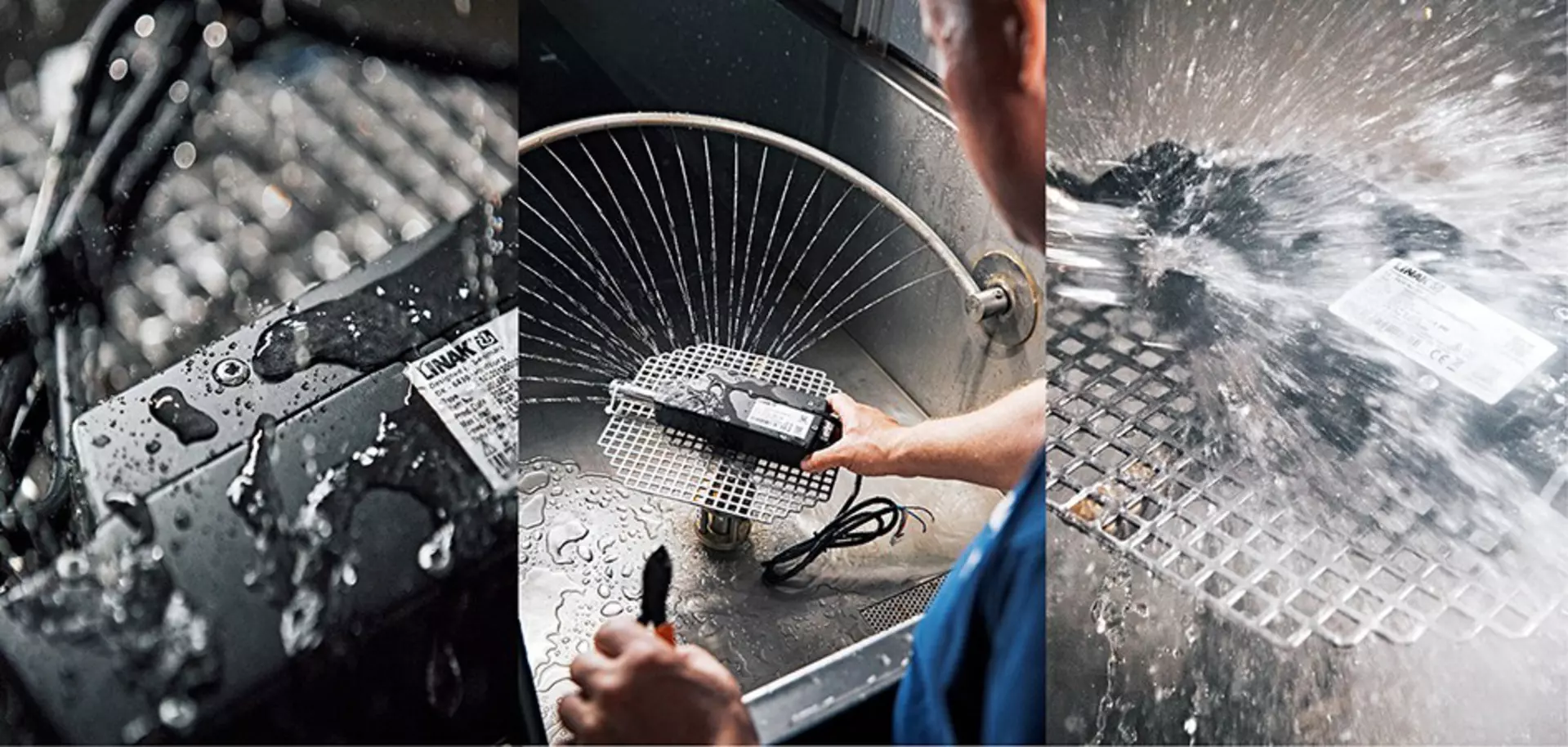
LINAK® actuators with IP66 and IP69K
Industrial actuators are typically used in environments where they are exposed to both liquids and solid objects. Therefore, all our actuators with aluminium housings are tested to meet ratings IP66 and IP69K, making them extremely versatile in various applications.
Good to know
Additionally, our actuators LA14, LA25 and LA36 are certified as explosion-proof, ensuring safe operation even in hazardous environments. This makes them ideal for industries requiring the highest safety standards.
For a deeper understanding of actuator technology, please refer to our detailed overview on what is an actuator.
Differences between IP66 and IP69K ratings
Actuators with IP66 rating are totally protected from dust ingress and powerful water jets from any direction. This makes these actuators suitable for outdoor use with changing weather conditions.
In case the application requires wash-downs with high-pressure water jets and high temperatures, IP69K is the recommended protection class. This is a common demand in, for example, agricultural machinery, where the actuator is not necessarily shielded or protected. Here the actuator is exposed to dirt, fertilisers and frequent high-pressure washing, typically at the end of a workday in the fields.
IP66
- Protected from total dust ingress
- Protected from high pressure water jets from any direction
IP69K
- Protected from total dust ingress
- Protected from steam-jet cleaning
This is how we test and determine Ingress Protection at LINAK
Visit the Actuator Academy™
Explore the aspects of what makes an actuator ideal for use with industrial machinery and discover the technology behind it.
Welcome to the LINAK Actuator Academy™

Actuators explained: Everything you need to know
Related documents

LA14
Linear actuators
Extremely durable short-range linear actuator for applications operating in rough environments. Ensures reliable performance in temperatures ranging from -40 to +85 Celsius.
- Max. load: 750 N
- Max. speed: 45 mm/s
- Stroke length: 19-130 mm
LA25
Linear actuators
Compact designed linear actuator ideal for narrow spaces. Comes with a high IP degree and aluminium housing and is suited to operate in almost any conditions.
- Max. load: 2,500 N
- Max. speed: 25 mm/s
- Stroke length: 20-600 mm
LA33
Linear actuators
The linear actuator LA33 from LINAK combines compact design with powerful performance. Available with high-speed option, I/O and low-noise gear option for even more customisation possibilities in demanding applications.
- Max. load: 5,000 N
- Max. speed: 70 mm/s
- Stroke length: 100-600 mm
LA36
Linear actuators
Extremely powerful linear actuator made by LINAK. Up to 6,800 N load, or up to 160 mm/s. Designed to operate in extreme conditions. A solid choice for industrial and agricultural applications.
- Max. load: 6,800 N
- Max. speed: 160 mm/s
- Stroke length: 100-1200 mm
LA37
Linear actuators
Extremely powerful linear actuator able to create reliable movement even in very harsh environments. It comes with LINAK IC Integrated Controller™ and a wide range of industrial control interfaces.
- Max. load: 15,000 N
- Max. speed: 10 mm/s
- Stroke length: 100-600 mm